Ask any logistics veteran, and they’ll tell you, the industry has never had a math problem. It’s always had a data problem. For decades, vital information has remained trapped in fragmented transportation management systems, broker portals, and manual workflows that operate in isolation. That’s why AI's biggest impact isn't in abstract optimization but in its power to finally normalize this messy, non-standardized operational data. It’s this foundational work on data infrastructure that finally unlocks practical, scalable use cases that were economically unviable just a few years ago.
To understand what this data unlock means for operators, we spoke with Veer Juneja, an expert at the intersection of technology and operationally-intensive environments. As the Co-Founder and COO of the Y Combinator-backed startup Fleetline, Juneja has built a career on solving thorny operational problems. He also previously founded and sold an EdTech company and served on a four-person trial team that won a nationally publicized case. His take? AI's real-world value isn't about the headlines. It lies deep within the foundational mechanics of data.
"AI is most helpful when it comes to taking unstructured, non-normalized data and making it usable," he says. "In trucking and logistics, the biggest bottleneck has always been integrations, because messy data couldn’t move cleanly between systems or drive real value. With an LLM filter in between, you can normalize all of that data, and that allows us to work with customers that we would not have been able to work with two or three years ago.”
In an industry where every company’s TMS is different, a one-size-fits-all approach often proves ineffective, making deep customization a key factor for adoption. But while AI-accelerated development makes this level of customization feasible, tech alone doesn't guarantee adoption. Building that trust means committing to educating users on how the technology works, demystifying the black box to build genuine buy-in.
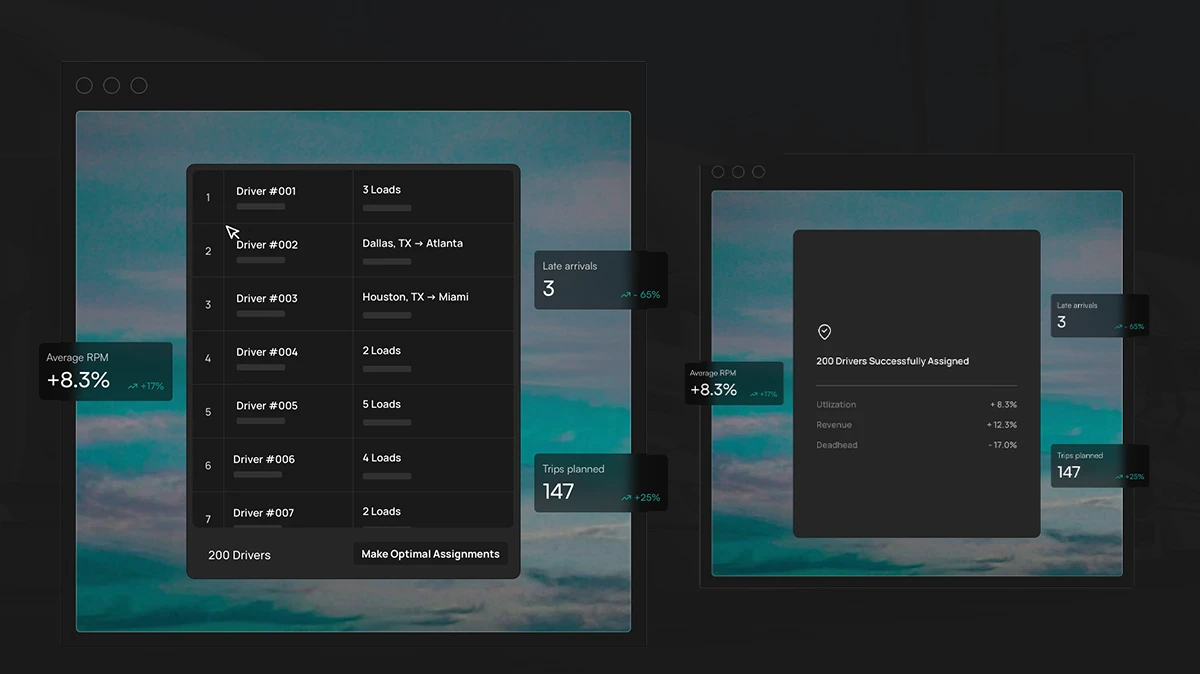
A factorial feat: Once that trust is built, AI can be unleashed on problems whose scale is so vast it becomes mathematically incomprehensible. It's at this massive scale that, for a growing number of operators, AI becomes a significant competitive edge, shouldering a burden that people simply cannot. "You have a 500-truck fleet spread across the country, with countless potential loads for each driver. It's impossible to conceptualize, yet humans are trying to choose between the quadrillions of ways we can organize our fleet. This is really a task for a complex computational process. That's the only way we're going to get anywhere near the right answer."
The future is custom: Looking forward, Juneja makes a counter-intuitive prediction: as AI makes development easier, the logistics industry will paradoxically grow even more fragmented. "My bet is that software development is just going to get easier and easier, to the point where most companies can develop their own TMSs in whatever customized way they want. Maybe that means more in-house TMSs or maybe it means more configurable platforms where you can type in a few prompts and get your own customized system."
A guerrilla's guide: In this hyper-customized world, he explains, innovators can't afford to wait for traditional integration partners. Large TMS providers are often unwilling to work closely with startups and can take over a year to provide a proper API, making a direct bypass the most logical tactic. Juneja believes the companies poised to win will be those that leverage AI to bypass traditional routes. They will take a guerrilla, do-it-yourself approach.
In a market drowning in hype, measuring the return on investment for new tools can seem like a dark art. So how do you measure success? When you view user trust as the prerequisite, the ultimate metric becomes refreshingly simple. For Juneja, the most telling signal of success is usage. He says active adoption is the ultimate proxy for a tool's value, user satisfaction, and the quality of its results.
Ultimately, the story of AI in logistics isn’t about replacing people, but empowering them. Positioned as a hedge against macroeconomic volatility, AI’s value, according to Juneja, is as a force multiplier, giving human workers the leverage to manage a higher volume of work and capture more value. "I don't think AI does a very good job of replacing workers right away, but AI does excel at empowering a single worker to do a lot more," Juneja concludes. "As the industry starts to rebound, your dispatchers can handle much more than they would have before. You don't need to add another 10, 15, or 20 people."