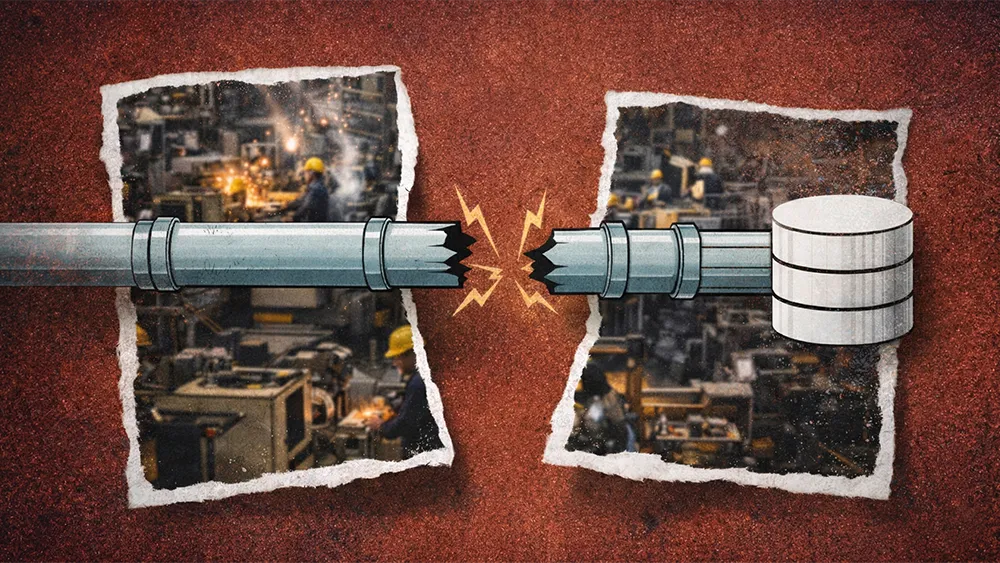
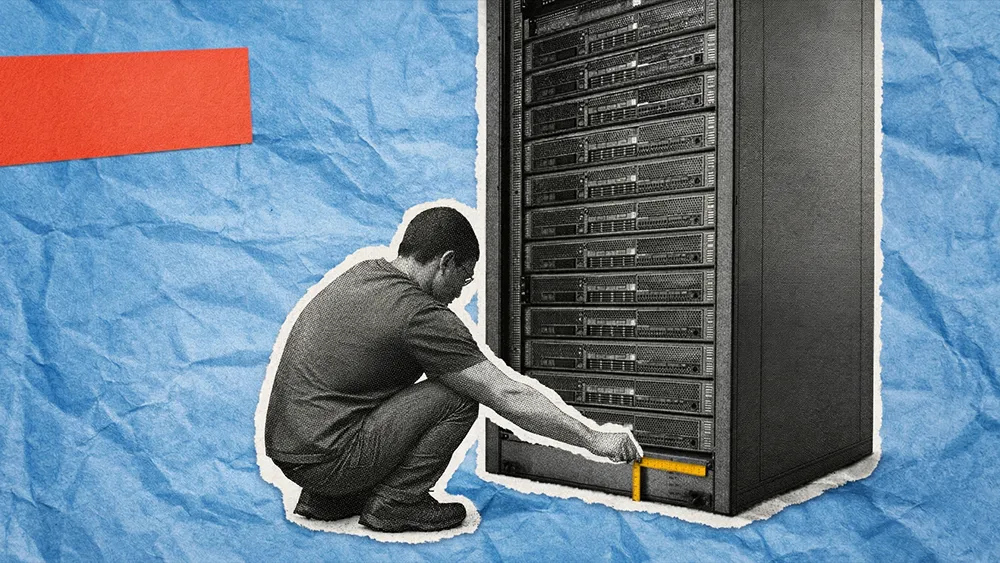
Most manufacturing AI fails before the algorithm ever runs. The failure point is not the model, the compute, or the data pipeline. It is the moment a technician in grease-stained gloves decides that walking 400 feet to a fixed terminal to log a micro-stop is not worth the effort. That observation stays in the operator's head, never reaches a system of record, and the predictive maintenance platform that cost seven figures continues running on a distorted map of reality.
Luca Ziveri, Chief Strategy Officer at SaidText, a voice-to-data platform that converts natural speech into structured, CMMS-ready tickets in under four seconds, calls this problem "Intangible Asset Impairment." Before joining SaidText, Ziveri scaled a manufacturing company from 500K to 5 million euros in revenue and co-founded a startup recognized as Italy's Best Start-Up by Millionaire magazine. His focus now is on eliminating the friction between frontline operators and the enterprise systems that depend on their input.
"On a factory floor, the cost of reporting a micro-stop is often higher than fixing it, so the data never gets captured. It stays in the operator's head as lost operational intelligence," Ziveri says. The industry has spent years optimizing databases and algorithms while neglecting the human-to-data interface where information is born.
The 21-Minute Tax: Ziveri quantifies the drag that existing digital tools impose on operators. "Tablets are office tools forced into an industrial environment," he says. The cumulative time lost per shift just navigating digital forms adds up to roughly 21 minutes of productivity drain. Worse, operator frustration filters the data itself, meaning the information that does make it into the system is incomplete and selective. "Their expensive AI is currently starving because the data quality coming from those tablets is filtered by operator frustration," he adds.
Reactive data feeding predictive models: The disconnect between AI ambition and data reality runs deep. "Most AI budgets are spent on predictive algorithms that run on reactive data," Ziveri explains. "If your data entry is manual, it's inherently late and incomplete. You are trying to predict the future using a distorted map of the past." Predictive maintenance only works when data capture is as fast as the event itself.
Traditional manufacturing metrics miss the actual value at stake. Ziveri argues that "hours saved" is misleading because the work does not disappear, it shifts. SaidText measures what he calls "Signal-to-Record Latency," the elapsed time between an event and its entry into a CMMS. When that gap stretches from seconds to hours, the operational intelligence embedded in shift handovers, near-misses, and verbal workarounds evaporates.
Compliance without reconstruction: For facilities operating under OSHA or ISO requirements, the biggest audit risk is retrospective logging, where technicians reconstruct details hours after an incident. "We provide the mechanism for contemporaneous documentation," Ziveri says. "By capturing the observation in real-time via voice, we ensure the data feeding the compliance report is accurate and timestamped." That makes the certification process more robust without adding steps to the operator's workflow.
Searchable tribal knowledge: When experienced operators retire or change shifts, their observations leave with them. Voice capture turns those passing remarks into structured, auditable records. SaidText's deployment at Cantiere del Pardo, an Italian luxury yacht manufacturer, delivered a 434% ROI and a 5 to 10 percent reduction in unplanned downtime within the first quarter.
Ziveri's longer-term vision strips the interface problem down to its simplest form. He describes an "Invisible Architecture" where data is a byproduct of work rather than an additional task. "The relationship would be simple: humans observe and speak, AI structures and routes, systems execute," he says. In that model, the technician becomes a knowledge worker whose primary tool is expertise, not a stylus. Until manufacturers fix the input layer, the AI systems sitting downstream will keep running on incomplete data and delivering incomplete results.