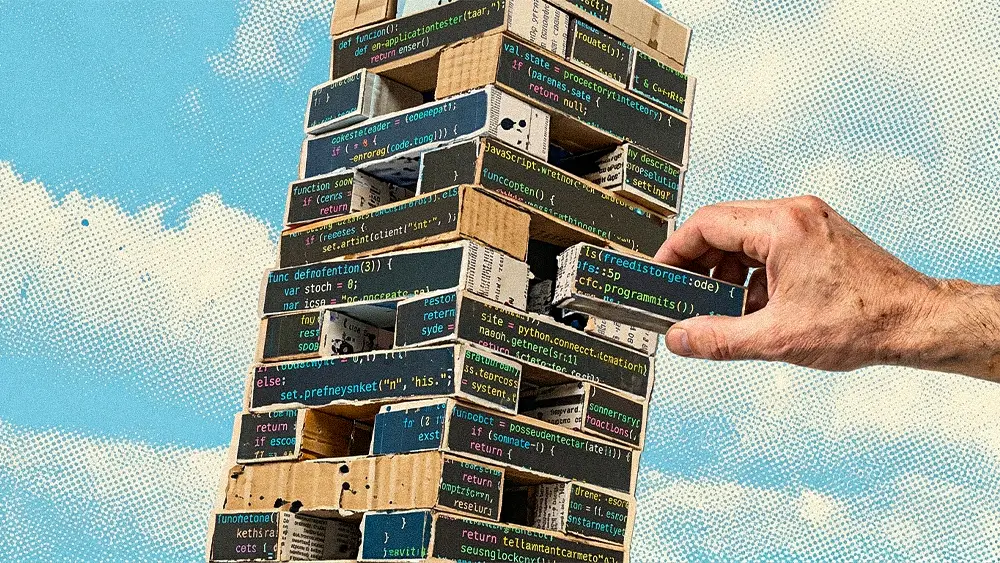
Every board wants AI. Funding gets secured, vendors get called, and somebody buys a license. What almost nobody wants to address is the data architecture underneath it: the fragmented systems, the duplicate records, the five platforms that do not talk to each other, and the employee spending 20 hours a week building one spreadsheet because there is no other way to pull the numbers together. That is where enterprise AI actually breaks, and it is the work that most organizations skip.
Aaron Pries is Director of Data Analytics at Bluenet, a data integration and analytics consultancy focused on financial services and regulated industries. His background spans cybersecurity consulting, systems administration at IBM, and pre-sales architecture across banking, credit union, and enterprise environments. He describes Bluenet as "the anti-hype AI company," one that frequently tells clients their problem can be solved with automation rather than AI and that the real work starts with data.
"A lot of these software platforms made one tool, and it does its job very well," Pries says. "But as we start living in more of a connected world, it's no longer acceptable to have one tool do that job very well. It needs to talk to these other systems now."
Fragmented systems create fragmented customers
Pries uses banking as the clearest example. A typical bank runs a core platform for account balances and transactions, a separate loan origination system, a CRM for customer demographics, and possibly additional tools for compliance or marketing. When those systems do not share data through integrated APIs, every platform creates its own version of the same customer.
"When you finally want to centralize it all in one place, you now have three different Zachary Stevenses," Pries says. "And it's this competing model of which one is the right one. The one who has the car loan, the one with the bank account balance, the one who opened a college account out of state." That identity fragmentation makes any downstream AI application unreliable. "AI is not a magic bullet. It's just really good at putting together insights quickly," Pries says. "But if that quality isn't there and it hasn't been architected well, it doesn't matter how much you invest."
He believes that data quality failures explain most of the reported AI ROI disappointments. "I would not be surprised if it's because companies are living in the Stone Age data-wise, and they want to plug in some AI tool and think it's going to 16x their business."
Most problems need automation, not intelligence
Pries pushes back on the instinct to apply AI to everything. "A lot of things that people come to me about can just be solved with dumb automation," he says. "Automation is the same thing over and over again. You don't need the intelligence aspect of that." The distinction matters for cost and compute. He cites a project where token costs were running high until an optimization reduced consumption by 80%. "Had we not gone through that exercise and really gone bug hunting, we would have just kept overusing the resources we needed."
SaaS products are not going away. Pries points to Salesforce as the example: it still handles permissions, access control, compliance certifications, and database-level security that no vibe-coded replacement can match. What changes is how people interact with those systems. Slack bots that query CRM data, pull meeting notes from SharePoint, and reference opportunity history are already becoming the primary interface for many users. "SaaS products aren't going anywhere," Pries says. "They're just going to evolve in how people use them."
The infrastructure shift outlasts the bubble
Pries draws the dot-com parallel directly. "A lot of people compare this AI bubble to the dot-com bubble," he says. "But even though there was a dot-com bubble, that era absolutely transformed the next generation of business. Amazon came out the other side of that." He sees the same pattern playing out with AI and data modernization. The hype cycle will correct. The underlying infrastructure shift will not reverse.
For legacy organizations still on the fence, Pries frames it simply. "If you think you're going to go another hundred years without adopting this, you're probably not going to be around," he says. "Hopefully you don't do what a lot of people do in cybersecurity, which is wait until it's too late and then spend twice as much." The real enterprise AI opportunity is not the model. It is freeing human intelligence from manual sorting, spreadsheet assembly, and fragmented data cleanup so that people can do the analysis and frontier-carving they were hired for.